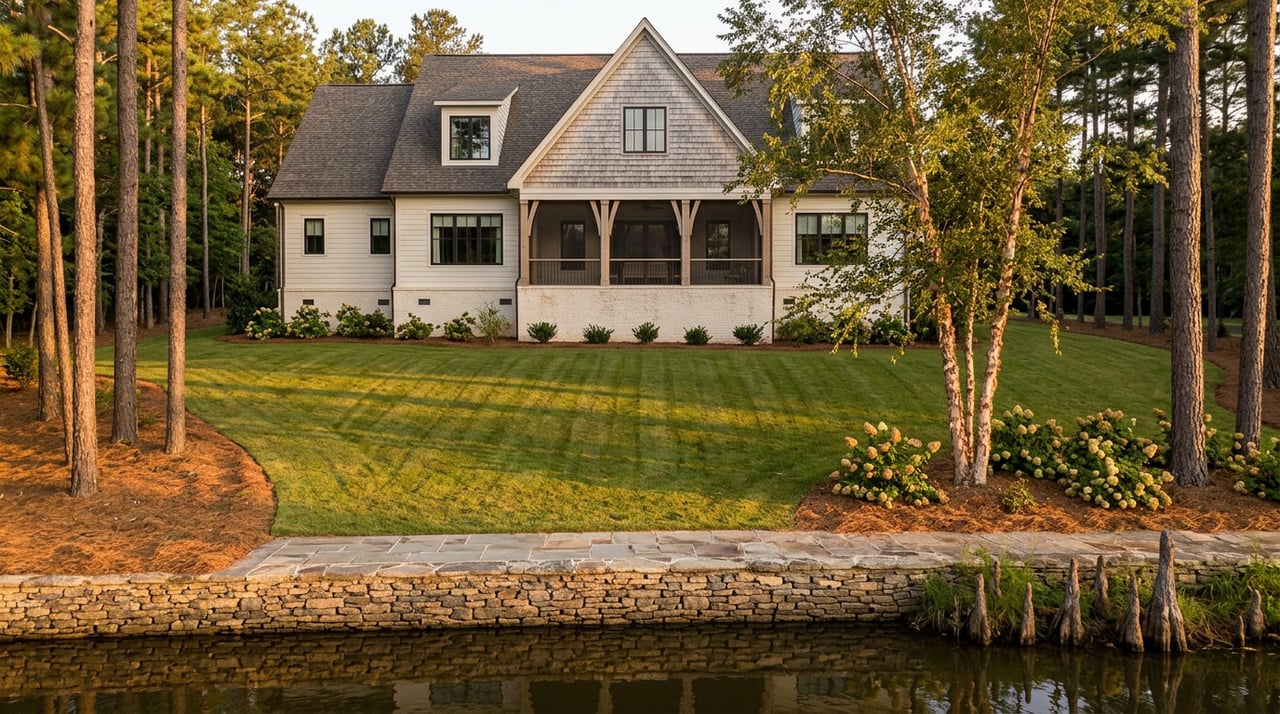
If you have lived in Whispering Pines for more than a few years, you already know the four-segment concrete structure holding back Thagard Lake predates most of the houses around it. Parts of the dam date to 1900. The newest section went in after the whole thing broke apart in July 1964, draining the lake for a year while crews rebuilt it. The lake itself carries the name of William C. Thagards, who put up a sawmill dam on the same stretch of the Little River back in 1866. This is not new infrastructure. It has failed before, and the Village has known for a while that it would need to fail-proof it again.
What has changed is the number attached to fixing it, and the timeline for when that fix actually starts.
Go back to the Frequently Asked Questions page the Village posted when it announced the Thagard Lake Dam Replacement Project, and the working estimate sits at $8 to $12 million. That page also lays out a specific sequence: geotechnical exploration beginning by September 2024, then 28 months of design, engineering, permitting and bidding, putting construction at January 2027, with completion by December 2028.
That was the plan as the Village described it in writing.
By June 2026, Sandhills Sentinel was reporting a different set of numbers. The project is now expected to cost more than $20 million, construction is described as potentially beginning "as early as 2028," and the design has settled on a specific structure: a new labyrinth-style spillway, a folded, zigzag design that lets a dam pass more floodwater without needing to be taller or wider.
Put the two side by side and the shift is hard to miss.
| Village FAQ (original estimate) | Reporting as of June 2026 | |
|---|---|---|
| Project cost | $8 to $12 million | More than $20 million |
| Construction start | January 2027 | As early as 2028 |
| Spillway design | Not yet specified | Labyrinth-style spillway |
That is not a rounding error. It is close to a doubling in cost and a full year of slippage on when dirt actually moves.
The Village's own explanation for why Thagard Dam needs to be replaced rather than repaired points to three specific findings from its inspections and investigations:
Any one of these findings on its own might have supported a repair. Together, on a structure with sections approaching or past 80 years old, they pushed the Village toward the more expensive path: build a new dam rather than keep patching pieces of an aging one. North Carolina's Dam Safety program classifies Thagard Dam as High Hazard, a designation based on the potential consequences downstream if it were to fail, not a prediction that failure is imminent. Thagard is also the largest of ten lakes, ponds, and dams the Village owns outright, impounding more than 103 million gallons of water. A structure that size, carrying that classification, does not get a modest fix. It gets engineered from scratch, and a labyrinth-style spillway capable of handling a design storm costs more to build than the simpler replacement the earlier estimate likely assumed.
The FAQ page set a target of beginning geotechnical exploration by September 2024. That work did not start on schedule. According to the Village's own Interim Manager's Monthly Report, a drilling barge was deployed on Thagard Lake on September 2, 2025, to begin waterside drilling, with the work expected to run two to three weeks. That is a full year behind the original target, and it was still the exploration phase, the step that comes before design, before permitting, before a shovel goes into the ground for construction.
So when the June 2026 reporting says construction may not start before 2028, it lines up with what was already visible on the water nearly a year earlier. The project was behind its own internal schedule before the cost estimate even got revised upward.
Thagard is not the only dam on the Village's plate. While the big project sat in design and geotechnical work, the Village was simultaneously handling repairs to the Spring Valley Dam. Three bids came in at an August 6, 2025 bid opening, ranging from $735,000 to $1,162,000, a fraction of Thagard's price tag and a project the Village could move on in months rather than years. Seeing both timelines next to each other is useful context: Spring Valley is a repair and maintenance job that fits inside a normal capital budget cycle. Thagard is a full rebuild that does not, and the gap between those two numbers is a fair measure of how much more serious the Thagard situation actually is.
The Village funds large capital projects like this through its Capital Reserve Major Repair Fund, built in part from a dedicated slice of property tax revenue, 10 cents for every $100 of assessed value, set aside automatically each year specifically for projects like dam repair. The Village's own FAQ projected that fund would hold an estimated $3.29 million as of July 1, 2025, a figure that already included roughly $1 million in revenue anticipated during the 2024-25 fiscal year.
The Village has also said it plans to pursue a FEMA High Hazard Potential Dam grant, which could cover up to 65 percent of total project cost, leaving the Village responsible for the remaining 35 percent match, likely drawn from that same reserve fund, possibly supplemented by a loan.
Here is where the growth of the village works in residents' favor. The Village's own financial reporting shows the budget for the fiscal year that closed this past June increased close to 12.7 percent over the year before, driven mainly by rising property tax revenue, which was projected to climb 17.5 percent as new homes continued to get built. A bigger tax base means a bigger annual contribution to that reserve fund without necessarily requiring a bigger rate. But that math was built around an $8 to $12 million target. Whether the reserve fund, the FEMA grant, and the growing tax base together can close a gap that is now closer to $20 million, or whether residents eventually see a loan or a rate adjustment attached to it, is the open question the Village has not yet answered publicly.
For day to day life on the lake, not much changes yet. The Village's own FAQ states it does not anticipate any impact on use of Thagard Lake Park at 12 South Lakeshore Drive from the project so far, though that could change once construction actually begins. The FAQ also confirms the lake level will likely need to be lowered at some point during construction, something the Village said would not happen before 2027 under the original schedule. Given that the schedule has since moved, that lowering is now tied to whatever the 2028 start date actually becomes once design work wraps.
If you want to track this yourself rather than wait for the next headline, the Village posts updates through its Manager's Monthly Reports and holds public meetings of the Lakes and Watershed Board, the group that oversees lake operations including this project. Both are worth signing up for if Thagard Lake is part of why you live here.
The dam has broken twice before in the last century. This time, the Village is trying to get ahead of a third break rather than react to it, and that kind of work rarely comes in at the first number anyone quotes. If you are weighing a move to Whispering Pines, or you already call one of its ten lakes home and want a straight answer about what a project like this means for the neighborhood, reach out to McDevitt Town & Country Properties. Jamie McDevitt has spent three decades tracking exactly this kind of local detail across Moore County, the sort of thing that does not show up on a listing sheet but shapes what it actually feels like to live somewhere.
This article is general information, not legal, tax or financial advice. Consult a qualified professional about your situation.
Jamie will take the time to understand your goals and will work tirelessly to help you reach them. Whether you are moving to the Pinehurst, Southern Pines area to play golf, swing a tennis racket, or simply run or walk through your neighborhood, let Jamie work for you.